July 17, 2017
Trusting and following intuitions often lead to a significant progress in scientific research. I have been trying to better understand the nature of intuition and make use of this fascinating tool. What we should all understand is that intuition really exists and it is not something abstract or mysterious. Although there are different views on how it functions, most modern scientists agree that it is a part of our extremely complex biological machine. In this post I will write about the role of intuition in an average research project and how a researcher should seek ways to exploit it, solely based on my own research experience. Please have a look at the external resources below for more reliable information.
Whatever we call them, intuitions, instincts* or gut feelings are an inseparable part of the progress in a research project. Especially in chemistry, chemical intuition is one of the scientist's most essential tools. This interesting post in Scientific American discusses that.
I have witnessed many fellow researchers choosing a surprising path or testing something extraordinary in their research project only because their "gut feeling" told them to do so and they succeeded. I have experienced the strength of gut feeling in many projects as well. It is difficult to describe how it works precisely but if your gut feeling tells you the wafer is not clean enough even after ten times washing they most likely are not clean enough. If your instincts tell you there is something wrong with the analytical instrument you have been using -although there is not a clear indication-, that is most likely true. Sometimes the intuition tool becomes even more interesting: the results you have been collecting recently are great but your gut feeling tells you something is wrong. Guess what, there is usually something wrong. These examples can be extended from nature sciences to mathematics or software development (I can imagine especially mathematicians relying often on their intuitions).
So how can a young researcher improve and exploit her intuitions? I really don't know if there is a best-practice to improve intuitions for using them specifically in research. What is clear to me is, if a researcher knows more, her gut feeling becomes sharper. Some detailed knowledge in the topic of her research is a must but any kind of general knowledge can help build a sharper and more reliable intuition.
In the end, intuition or gut feeling is probably no more than a subconscious processing of all the known information and coming to a decision -again- subconsciously. It is a kind of pattern recognition. Let us take a simple example and try to correlate intuition to simple visual pattern recognition. In the image below, dots might represent an object depending on how one connects them. Imagine someone that neither saw a fish nor a house in their life. This person would most likely see these dots just as dots. A fisherman on the other hand would probably first think of a fish and an ancient architect grew up in a desert would first see a house (I imagined that poor architect does not have access to fish at all). Some other person with enough knowledge would recognize both patterns and maybe see even more objects beneath, such as a pine tree, etc. So prior knowledge defines how a person recognizes visual patterns and in a similar way it defines how a researcher makes use of her intuition.
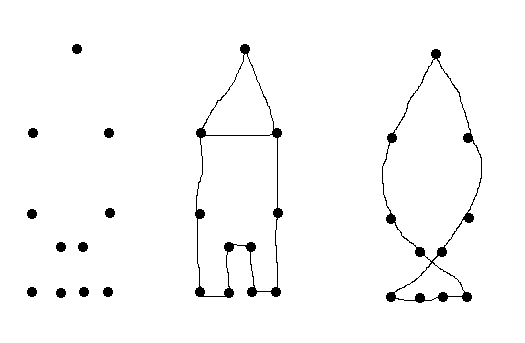
Visual pattern recognition mechanism uses visual patterns as external input and prior knowledge as internal input and generates an output (house, fish, etc.). Intuition can use all common five senses (sight, sound, smell, taste, touch) and their combinations as external input and prior knowledge as internal input, making it an extremely complex tool. Clearly, external and internal inputs only work together to solve complex problems, otherwise they are useless.
So, how should a researcher build up a strong, efficient knowledge base and use it as the internal input in her intuition tool? My experience tells me definitely systematically and not by intuition or gut feeling. Trying to sharpen intuitions intuitively is like trying to sharpen a saw with another saw: it sounds like it is doable but it is not the best way. It took me a while to figure it out but a loop of systematic search for knowledge - a logical experiment plan - using intuitions during experiments worked well for me. I will write about systematic literature search and systematic experimentation in a future post.
External resources:
The articles below have a more objective language and include more scientific information.
1- A scientific article titled "Research: intuition and logic"
2- A post from Association for Psychological Science: Intuition - It's more than a feeling
3- The science behind intuition posted in one of my favorite psychology websites, Psychology Today
* Intuition and instinct are not exactly the same things but in this context I used them interchangeably.
Dr. Çağrı Üzüm